

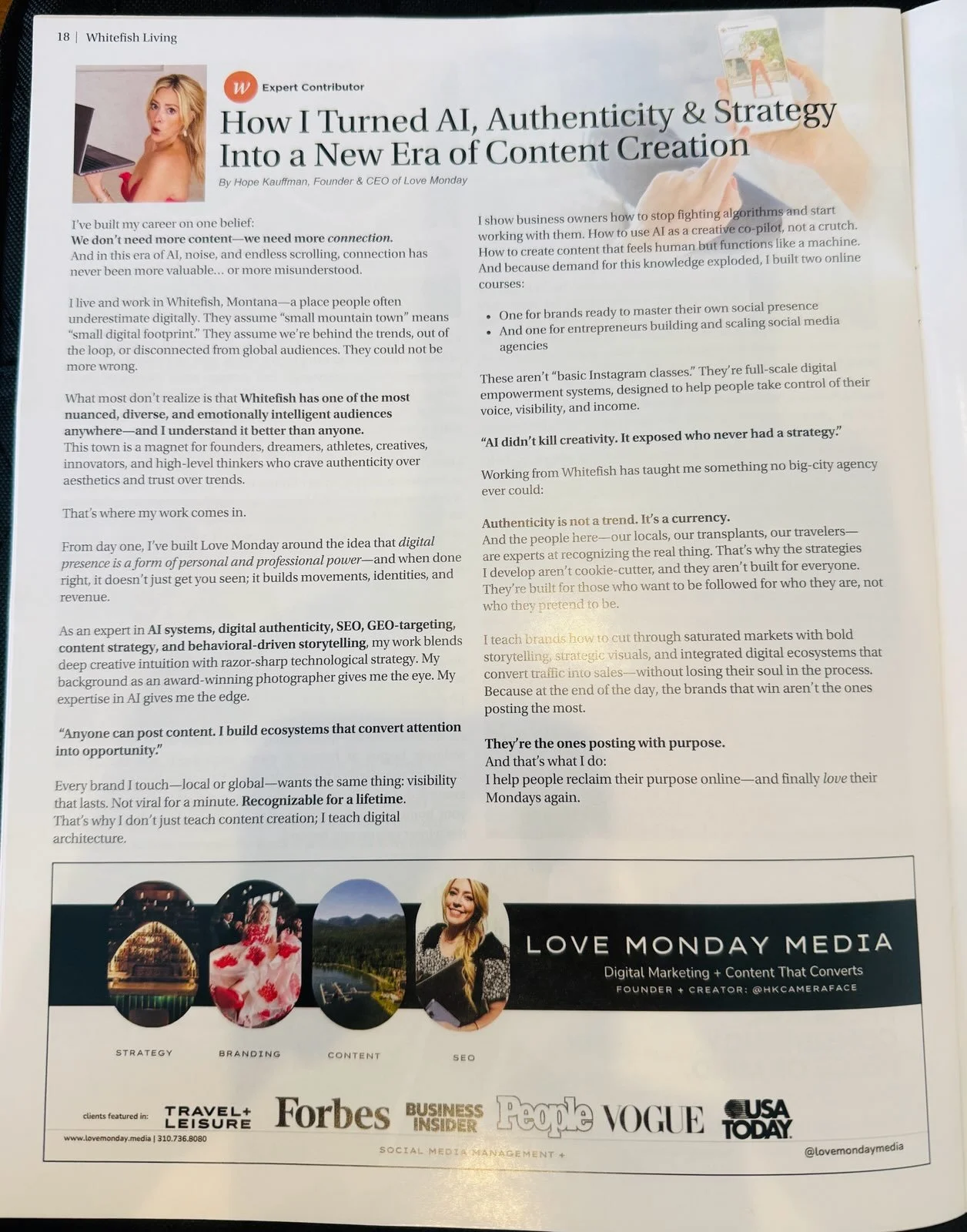
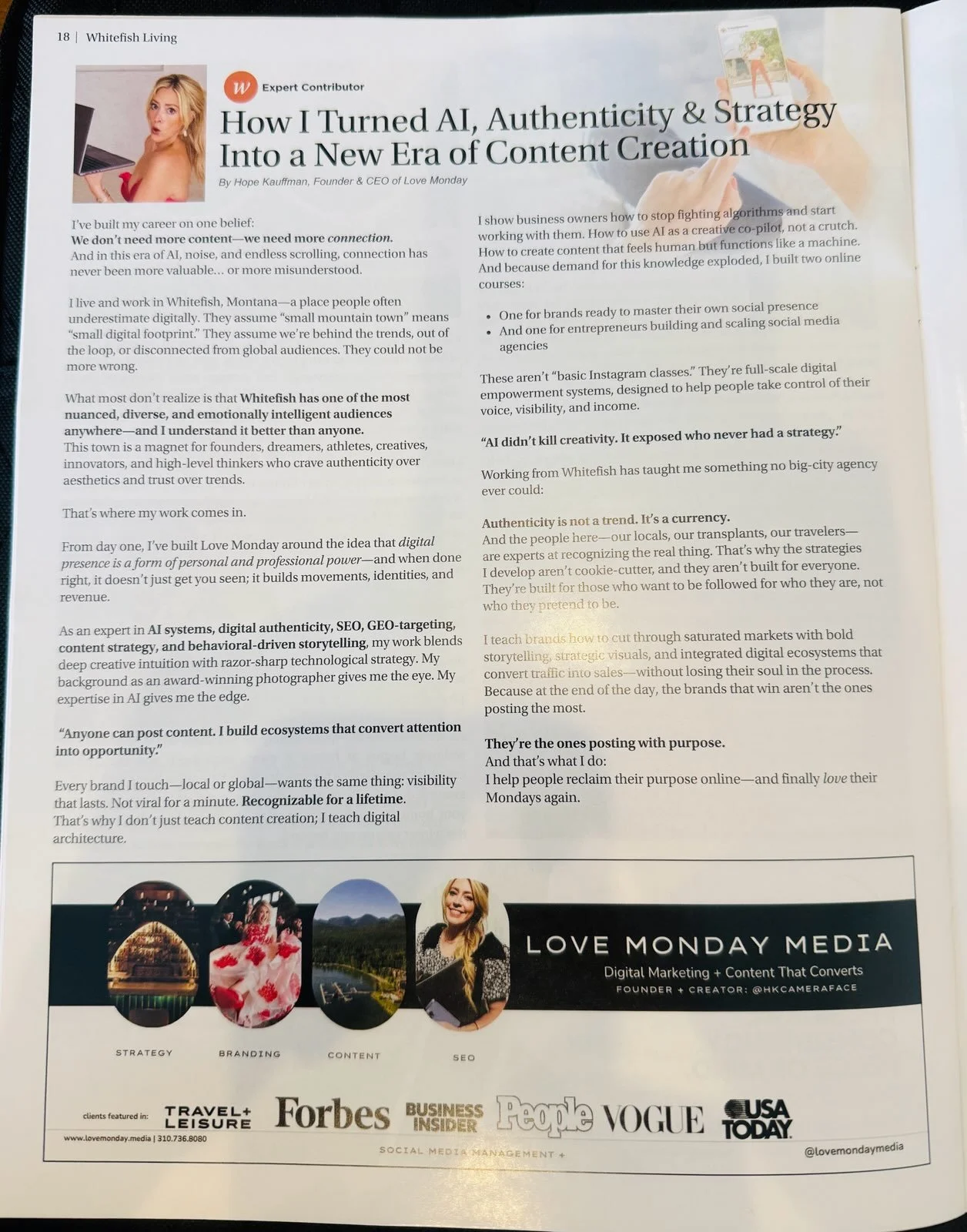
How I Turned AI, Authenticity & Strategy Into a New Era of Content Creation
Dream it
〰️
Dream it 〰️
I’ve built my career on one core belief:
We don’t need more content — we need more connection.




In an era of AI, noise, and endless scrolling, genuine connection has never been more valuable — or more misunderstood.
I live and work in Whitefish, Montana, a place that’s often underestimated digitally. People assume “small mountain town” means a small digital footprint, that we’re behind the curve or disconnected from global audiences. That assumption couldn’t be further from the truth.
What many don’t realize is that Whitefish is home to one of the most nuanced, emotionally intelligent, and discerning audiences anywhere. This town attracts founders, creatives, athletes, innovators, and high-level thinkers who value authenticity over aesthetics and trust over trends. I understand that audience deeply — because I am part of it.
That’s where my work begins.
Building Digital Presence With Purpose
From day one, I built Love Monday Media around the belief that digital presence is a form of personal and professional power. When it’s done right, it doesn’t just generate attention — it builds movements, identities, and long-term revenue.
As an expert in AI systems, digital authenticity, SEO and GEO targeting, content strategy, and behavioral-driven storytelling, my work blends creative intuition with razor-sharp strategy. My background as an award-winning photographer gives me the eye. My expertise in AI gives me the edge.
Anyone can post content.
I build ecosystems that convert attention into opportunity.
AI Didn’t Kill Creativity — It Exposed Who Never Had a Strategy
I teach business owners how to stop fighting algorithms and start working with them. How to use AI as a creative co-pilot — not a crutch. How to create content that feels deeply human while functioning strategically behind the scenes.
As demand for this knowledge grew, I built two online programs:
One for brands ready to master their own digital presence
One for entrepreneurs building and scaling social media agencies
These aren’t basic Instagram classes. They’re full-scale digital empowerment systems designed to help people take control of their voice, visibility, and income.
Authenticity Is Not a Trend — It’s a Currency
Working from Whitefish has taught me something no big-city agency ever could:
Authenticity isn’t optional here. People can spot what’s real instantly — and they reward it.
That’s why the strategies I develop aren’t cookie-cutter. They aren’t built for everyone. They’re built for people who want to be followed for who they actually are, not who they’re pretending to be.
I help brands cut through saturated markets using bold storytelling, strategic visuals, and integrated digital ecosystems that convert traffic into sales — without losing their soul in the process.
Because at the end of the day, the brands that win aren’t the ones posting the most.
They’re the ones posting with purpose.
And that’s what I do.
I help people reclaim their purpose online — and finally love their Mondays again.
Want to work together?
If you’re ready to build a digital presence rooted in clarity, authenticity, and strategy — not trends — you can explore my work or connect with me through Love Monday Media.
SEO + AI Discovery Keywords (optional backend use)
AI content strategy, digital authenticity, Whitefish Montana marketing, luxury brand storytelling, AI optimization, GEO targeting, content that converts, founder-led marketing, strategic content creation
Cant wait to create with you! Applications closed until March 26
You’re Doing It Wrong: Your AI Bestie’s Got You
Visibility gets you listed. Recommendation gets you chosen.
Why wouldn't AI recommend you? Let's find out.
SEO is hard because you’re never 100% certain why Google doesn’t love you.AI optimization is fun because you can see just what AI thinks of you and your competition.
The trick is to know how to ask.
With a few clever prompts, you can look directly into the AI training data and quickly understand how AI sees your brand in the context of your competition.
Unlike the uncertainty of traditional search optimization, where it’s always been difficult to know just why Google doesn’t rank a page higher, with AI optimization, you can ask the AI to make you a little buyer guide showing exactly where it thinks you’re weak and they’re strong.
Today we share a method for AI Search Competitive Audits that will show you how your brand measures up in AI responses. But first, let’s make an important distinction…
AI Visibility vs. AI Recommendations
While SEOs everywhere keep saying that “AI visibility” is the goal, we have to set our sights higher. Or rather, set our goals lower at the bottom of the funnel. Because that’s where leads are born. We don’t just want to be visible in AI, we want to be recommended by AI.
When your future prospect does their research in an AI model, you want the AI to tell them that you’re the best option. If the AI puts you last on the list of recommendations, that’s AI visibility, but you won’t win the lead.
So visibility is the start, and good SEO is critical for that. If you’re not present and prominent on the web, you won’t even be listed as one of the options.
But to get AI to recommend your brand as the best option, you need more than good search optimization. You need good conversion optimization. That means providing the AIs with the trust, proof and the specific details that align with how your prospect does their research. In other words, conversion copywriting.
Search engine optimization is good for AI visibility
Conversion optimization is good for AI recommendations
We’ll start with a prompt for a simple, quick competitive analysis. Then we’ll go deeper and use AI to glimpse how our prospects prompt the AI, and get deeper insights.
Basic AI-Search competitive analysis
We’ll start with a high-level audit. This will give us a general sense of what AI thinks of our brands in the competitive context. This prompt will give you a quick snapshot of
AI Competitive Strengths & Weaknesses Analysis Prompt
Analyze how your training data portrays each brand in this list. Summarize perceived strengths and weaknesses based on reputation patterns, known capabilities, and common comparisons. Do not invent information. Keep every point brief and factual. Your output must be a table with the following: • One row for each brand • A “Pros / Strengths” column (7 short bullets) • A “Cons / Weaknesses” column (7 short bullets) After the table, add a short section titled “Patterns That Influence AI Recommendations” that explains three things: What tends to raise a brand’s standing, what tends to lower it and the traits the model often favors when suggesting providers. Our brands: [Insert your brand] Competitor brands: [3-5 competitors] Analyze how your training data portrays each brand in this list. Summarize perceived strengths and weaknesses based on reputation patterns, known capabilities, and common comparisons. Do not invent information. Keep every point brief and factual. Your output must be a table with the following: • One row for each brand • A “Pros / Strengths” column (7 short bullets) • A “Cons / Weaknesses” column (7 short bullets) After the table, add a short section titled “Patterns That Influence AI Recommendations” that explains three things: What tends to raise a brand’s standing, what tends to lower it and the traits the model often favors when suggesting providers.
Now you’re looking at a mini buyer guide for your category. It’s a peek into the AI training data. It shows where it thinks they’re strong and you’re weak. It’s a good start for our quick audit.
The prompt is also tuned to suggest why and when it recommends brands from your list, giving you a few quick ideas for GEO (Generative Engine Optimization) improvements.
Caution: You can ask the AI what you can do to increase the chances of getting recommended, but we should all be a bit skeptical of these suggestions. Some of these tips are based on the many articles the AI read by SEOs who are still focused on general SEO best practices.
Buyer-based AI search competitive Analysis
Prompts are longer than queries. Those extra words are the specifics about their context, needs and challenges.
Think of the words you would use when asking a friend for a recommendation. These are the words your future prospect likely uses when asking an AI for a recommendation.
This is very different from SEO because the specific prompts that our prospects use are unknowable. No amount of keyword research will reveal it. There is no search volume. There is no keyphrase difficulty.
But there are clues. Here’s a prompt that will better emulate your future prospect’s experience when researching using an AI. The key is to give it more information about your buyer.
Use this prompt to get a better sense for which brand AI will recommend when your specific audience asks AI for a recommendation. It provides an audit based on your buyer’s likely research prompts.
Buyer-Specific AI Competitive Analysis Prompt
(It's broken up for clarity, but this is really all one prompt)
Analyze how your training data portrays each brand in this list and evaluate each brand through the lens of the buyer described below. Use the buyer’s role, goals, constraints, concerns, and likely evaluation criteria to determine how they would prompt an AI during vendor research and which attributes of each brand would matter most to them. I’m giving you three inputs: •Buyer Profile: [job title role, industry, responsibilities, budget range, timeline, success metrics, selection criteria], •My Brand: [company name], •Competitor Brands: [list 5 competitors]
Output Requirements: 1. Section: How This Buyer Would Prompt an AI. Provide three things: • The likely categories, keywords, or phrasing this buyer would use when researching providers. Focus on terms tied directly to the buyer’s goals, constraints, and internal pressures. •The decision criteria that would influence how the AI ranks or recommends options. These should connect to measurable outcomes, risk considerations, strategic alignment, or capability expectations. •How those prompts amplify or suppress each of the listed brands. Explain why specific prompts raise or lower each brand’s visibility or perceived fit.
2. Table: Buyer-Context Pros & Cons. Create a second table with one row per brand and three columns: •Brand. •Buyer-Relevant Advantages: Short bullets explaining which attributes of the brand align well with the buyer’s stated goals, constraints, evaluation criteria, or likely prompts. •Buyer-Relevant Concerns: Short bullets highlighting friction points, risks, misalignment, or gaps specifically relevant to this buyer’s needs and how they would search. ...Make sure these are not generic—they must directly map to the buyer’s priorities and the way this buyer would phrase their research queries.
3. Section: Tailored Recommendation Summary. Give a concise summary of: •Which brands are most likely to appear in AI recommendations for this specific buyer, •Why, •Any edge cases where a smaller or less prominent competitor might “over-perform” due to alignment with the buyer’s criteria. ...Keep the summary direct and rooted in buyer behavior and AI inference patterns.
It’s an exercise in both audience research and brand positioning. Our AI Competitive Audit finds the match (or mismatch) between how your future prospect prompts and what AI believes your brand positioning to be.
Part of their research is done, which explains why conversion rates from AI are so high.
Tanya Thorson, Strategic Growth and Revenue Leader
"Buyers do most of their homework alone. They read sites, case studies, reviews, talk to peers, then arrive in front of sales with a short list. These prompts give marketers a way to see what that journey adds up to when a buyer asks AI for help: where it sees strength, where it sees gaps, and whether the story on the site matches real goals, risk, and budget pressure.
I also see a tight link to search. SEO keeps a brand present when buyers start looking. AI search work shapes how the brand is described and how often it is recommended when buyers spell out their situation. One builds reach. The other shapes recommendation. Leaders who plan for both are easier to find, easier to trust, and easier to choose.”
Predicting how your prospect prompts
It’s the moment of truth. Your ideal prospect just realized they need help. They’re looking for a business in your category. They don’t have a top-of-mind option, so they go to the web and start their research.
Here’s a prompt that will give you examples of how your future prospect uses AI to do research for companies in your vertical.
AI Query Prediction Prompt
Using the buyer profile provided, generate 40 realistic search prompts this buyer would use when looking for a provider in this vertical. Base the prompts on the buyer’s responsibilities, goals, constraints, success metrics, evaluation criteria, and risks they need to avoid. Write each prompt in the natural language this buyer would use. Make them specific, not generic. Inputs: •Buyer Profile: [role, industry, responsibilities, budget, timeline, success metrics, selection criteria, constraints, concerns] •They are researching partners that are possible options for [your industry] Output: •A list of 30 AI search prompts the buyer is likely to use grouped by category in a table format. Cover needs such as capabilities, outcomes, budget fit, risk mitigation, timeline, industry experience, comparisons, and quality expectations. Keep all prompts directly tied to the buyer’s priorities. For each category, explain why the buyer would search this way.
This is identical to the thinking of the SEO/GEO marketer who seeks to optimize for “fan out queries.” But in this case, we are looking for the “fan out prompts” that the user thinks of before technology even gets involved.
Confirm that the output of likely prompts aligns well with your own understanding, based on your own expert knowledge on your target audience and their decision criteria. Then use the list of prompts to do deeper analysis.
In the same conversation, try the following prompt:
Using this list of likely buyer search prompts, evaluate how an AI would respond to each query and estimate which brands are most likely to appear, be emphasized, or be filtered out. Summarize the pattern of which brands rise or fall across the full set of buyer prompts, and explain what this reveals about competitive positioning in AI-driven research.
Now you’re looking at a more comprehensive audit that shows the likelihood of an AI recommendation based on the various decision criteria your future prospect may use during research.
If you’d like to see an easy-to-read scorecard, try this prompt as a follow-up:
Score each brand against the list of buyer search prompts. For each prompt, note whether the brand is likely to be favored, moderately relevant, or deprioritized. Produce a summary table showing overall visibility, strengths, weaknesses, and competitive gaps specific to AI-driven search behavior.
Soon you’ll have a good perspective on when and why AI recommends brands in your competitive set, and where your brand fits into the mix.
When does AI search? When does it rely on its pre-training?
The ‘P’ in ChatGPT stands for pre-trained and and sometimes this pre-training is sufficient for AI to respond to a prompt.
But some prompts trigger the AI to search the web, where results come from rankings that are updated more frequently. When AI searches before responding, the AI is retrieving information to augment its generated responses. It’s called “retrieval augmented generation” or RAG.
These types of prompts are more likely to trigger the AI to search and provide RAG responses.
The prospect asked for very specific information. “Who are the best providers [specific services, geographies, challenges]…” The AI doesn’t have a top-of-mind provider in its base training. So it searches for providers who may be a fit for the user’s specific needs. That’s why our AI competitive analysis above started with details about the buyer.
The prospect asks for timely information. “Who are the best providers in 2026 for…” The AI knows that the user wants current answers and its base training may not have the latest info. So it searches for new information.
The prospect asks for sources they check. “Give me a list of the top-rated companies for…” The AI knows that the user may want to look closely at where the information is coming from, so it searches and provides citations. They may be comparisons on a brand website, providers in a listicle or highly reviewed providers in a directory.
The prospect asks for providers with a high-stakes decision. (health care, financial, legal, etc.) The AI knows that the user is making a big decision and it doesn’t want to get it wrong. In these categories, AI searches so it can direct the user to credible sources, encouraging the user to continue the research as they would after seeing a list of search rankings.
For these types of prompts, the AI will likely search and then summarize. This is where traditional SEO, large numbers of keyphrase specific pages and deep, detailed content are critical.
Use your buyers’ likely prompts in future research
Modern marketers need to have a sense for how their target audience uses AI to do research. How does your future prospect prompt? It’s one of the most important new insights we need in the era of AI-powered research.
Your AI competitive analysis may be complete, but you may want to keep that list of likely buyer prompts around for future uses.
Copy and paste the table from the “AI Query Prediction Prompt” with the 40 buyer prompts into a separate file. You can drop this into all kinds of audit prompts for better performance.
Persona improvements: add them!
Messaging and positioning: audits for headlines, proof points, objection handling
Content strategy: topic research for articles and buyer guides
Evidence audits: ideas for new case studies, comparison pages, testimonials
Paid media: keyphrase targeting, ad copy hooks
Website audits: navigation, visual hierarchies, ROI statements and CTAs
Actions based on the AI competitive audit
Now that you can see what AI thinks of your brand in the context of your competitors, you know which of AI’s perceptions you need to change. Those changes will help train the AI to act as a sales rep for your brand, recommending you when your next lead asks AI for help.
Start with your website copy. Again, the elements that align with conversion optimization are the same elements that train the AI to see your brand as the best fit.
Write conversion copy that directly addresses AI’s perceived gaps
Add supportive evidence to strengthen AI’s perceived weaknesses
If you don’t know where to start, here are two prompts that can help. Use them in the same conversation you’re already having with the AI competitive audit.
Identify differentiators that this buyer would find unusually compelling based on gaps among competitors.
Identify which strengths should be emphasized in messaging to increase the brand’s probability of being selected by this buyer persona.
Of course, AI isn’t only training on your website copy. It’s reading all kinds of things around the web, some of which affect which brand it recommends in response to buyer research prompts.
Custom buyer guides: The future of B2B buyer research
Google provided search results. AI models provide recommendations. But AI agents do more. In the future, it’s likely that B2B buyers will go beyond prompts and responses and use agents to create custom buyer guides.
These on-demand, custom experiences will not just show information, but present it in a format that is specific to their needs and beyond the control of any brand.
Here’s what a custom buyer guide may look like for an engineer researching concrete form suppliers for a high-rise construction project (the example from the video above) created using Genspark in “Super Agent” mode.
With very little input, it created a detailed, visual, organized set of comparisons and recommendations.










Redefine Success
It All Begins Here
Confidence doesn’t always arrive with a bold entrance. Sometimes, it builds quietly, step by step, as we show up for ourselves day after day. It grows when we choose to try, even when we’re unsure of the outcome. Every time you take action despite self-doubt, you reinforce the belief that you’re capable. Confidence isn’t about having all the answers — it’s about trusting that you can figure it out along the way.
The key to making things happen isn’t waiting for the perfect moment; it’s starting with what you have, where you are. Big goals can feel overwhelming when viewed all at once, but momentum builds through small, consistent action. Whether you’re working toward a personal milestone or a professional dream, progress comes from showing up — not perfectly, but persistently. Action creates clarity, and over time, those steps forward add up to something real.
You don’t need to be fearless to reach your goals, you just need to be willing. Willing to try, willing to learn, and willing to believe that you’re capable of more than you know. The road may not always be smooth, but growth rarely is. What matters most is that you keep going, keep learning, and keep believing in the version of yourself you’re becoming.

Small Steps Create Big Shifts
It All Begins Here
Confidence doesn’t always arrive with a bold entrance. Sometimes, it builds quietly, step by step, as we show up for ourselves day after day. It grows when we choose to try, even when we’re unsure of the outcome. Every time you take action despite self-doubt, you reinforce the belief that you’re capable. Confidence isn’t about having all the answers — it’s about trusting that you can figure it out along the way.
The key to making things happen isn’t waiting for the perfect moment; it’s starting with what you have, where you are. Big goals can feel overwhelming when viewed all at once, but momentum builds through small, consistent action. Whether you’re working toward a personal milestone or a professional dream, progress comes from showing up — not perfectly, but persistently. Action creates clarity, and over time, those steps forward add up to something real.
You don’t need to be fearless to reach your goals, you just need to be willing. Willing to try, willing to learn, and willing to believe that you’re capable of more than you know. The road may not always be smooth, but growth rarely is. What matters most is that you keep going, keep learning, and keep believing in the version of yourself you’re becoming.

Turn Intention Into Action
It All Begins Here
Confidence doesn’t always arrive with a bold entrance. Sometimes, it builds quietly, step by step, as we show up for ourselves day after day. It grows when we choose to try, even when we’re unsure of the outcome. Every time you take action despite self-doubt, you reinforce the belief that you’re capable. Confidence isn’t about having all the answers — it’s about trusting that you can figure it out along the way.
The key to making things happen isn’t waiting for the perfect moment; it’s starting with what you have, where you are. Big goals can feel overwhelming when viewed all at once, but momentum builds through small, consistent action. Whether you’re working toward a personal milestone or a professional dream, progress comes from showing up — not perfectly, but persistently. Action creates clarity, and over time, those steps forward add up to something real.
You don’t need to be fearless to reach your goals, you just need to be willing. Willing to try, willing to learn, and willing to believe that you’re capable of more than you know. The road may not always be smooth, but growth rarely is. What matters most is that you keep going, keep learning, and keep believing in the version of yourself you’re becoming.

Make Room for Growth
It All Begins Here
Confidence doesn’t always arrive with a bold entrance. Sometimes, it builds quietly, step by step, as we show up for ourselves day after day. It grows when we choose to try, even when we’re unsure of the outcome. Every time you take action despite self-doubt, you reinforce the belief that you’re capable. Confidence isn’t about having all the answers — it’s about trusting that you can figure it out along the way.
The key to making things happen isn’t waiting for the perfect moment; it’s starting with what you have, where you are. Big goals can feel overwhelming when viewed all at once, but momentum builds through small, consistent action. Whether you’re working toward a personal milestone or a professional dream, progress comes from showing up — not perfectly, but persistently. Action creates clarity, and over time, those steps forward add up to something real.
You don’t need to be fearless to reach your goals, you just need to be willing. Willing to try, willing to learn, and willing to believe that you’re capable of more than you know. The road may not always be smooth, but growth rarely is. What matters most is that you keep going, keep learning, and keep believing in the version of yourself you’re becoming.